Mall kiosk fit out Dubai: approvals, programme, cost
A mall kiosk fit out in Dubai is approved twice before anyone drills a hole: first by the mall operator's design review, then by Dubai Municipality. The build itself is often a handful of night shifts. The approval path is what decides whether you trade on your launch date.
Kiosk, pop up or shop unit: the route changes with the footprint
A kiosk is a trading unit standing in the mall's common area, usually under 30 sqm, open on one or more sides, with no full-height walls of its own and no back-of-house. A pop up shop is the same idea with an expiry date: an atrium stand, a branded container, a short lease on a vacant unit. A standard shop unit is demised space behind a shopfront, with its own MEP connections and a ceiling at the mall's standard height.
That is why the approval route differs. A shop unit is mostly judged on what happens inside your own walls. A kiosk sits on the mall floor, under the mall's sprinkler coverage, drawing from the mall riser and visible from every level of the concourse. Operators review it as an intervention in common area, so sightlines, branding height, illuminated signage, ceiling treatment, materials and the exact demarcation line are checked against their design manual before Dubai Municipality sees a drawing. The full shop-unit route is covered in our guide to retail fit out in Dubai; kiosk scope is a subset with a stricter review.
The mall operator comes first, then the NOC, then DM
The order we run, and each step needs the document from the one before it:
- Concept and detailed drawings: layout, elevations, section, signage, MEP single line, material samples.
- Mall design review, handled by the operator's tenant coordination team.
- NOC from the mall. Dubai Municipality will not accept a permit application without it.
- DM building permit, submitted with the NOC, the drawings and the contractor documents.
- Works, inside the access window the mall gives you.
- Mall inspection, snag close-out, then trading.
Two things trip people. Branding is reviewed together with the elevations, so logo artwork goes in with the layout package; a file that arrives late restarts the comment clock. And the NOC is issued to the tenant, not the contractor, so someone on your side has to chase it.
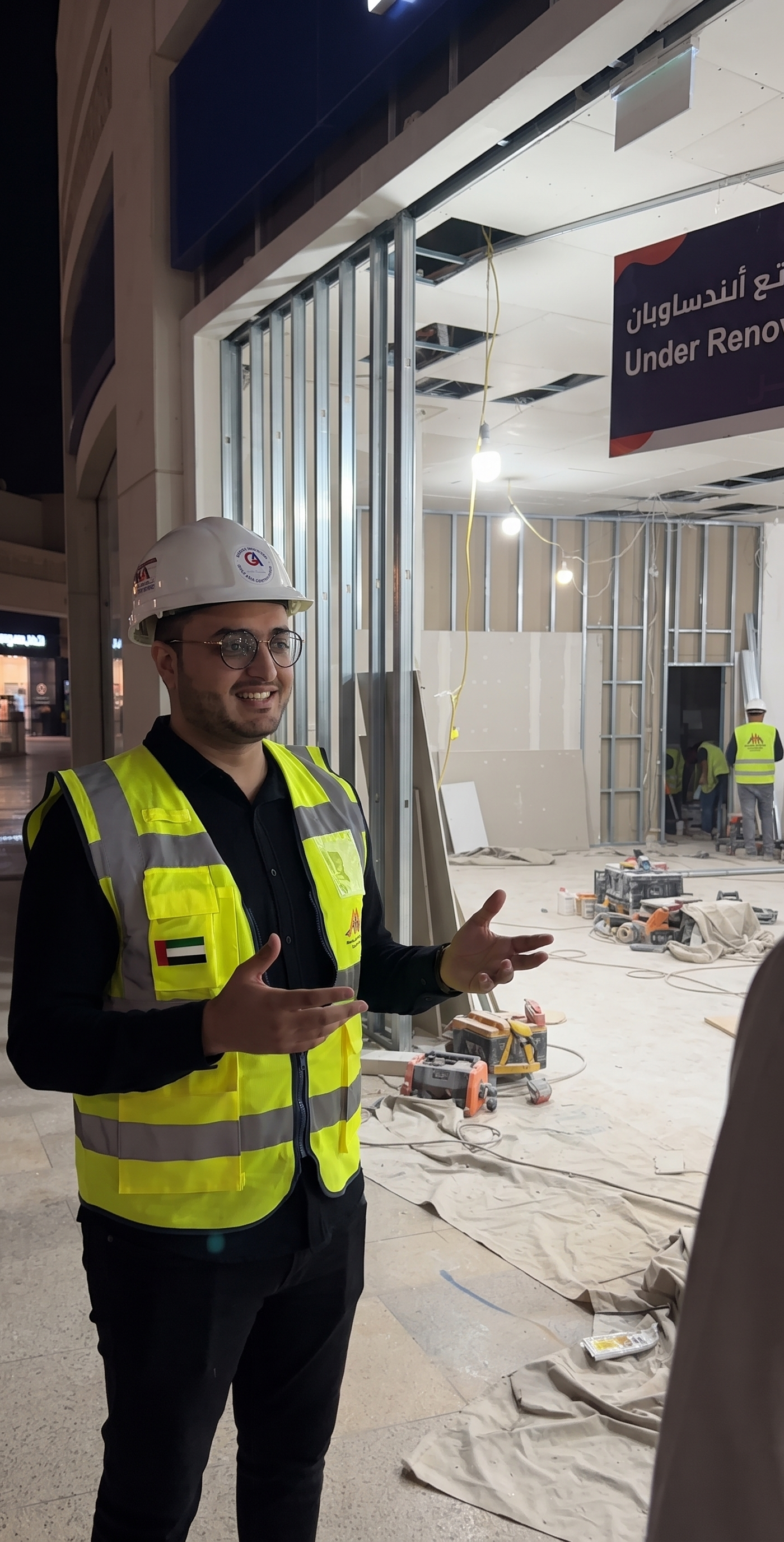 Framing and drywall going up in a commercial unit. Kiosk shells are usually built off site and assembled inside the mall's night access window.
Site conditions that set your programme before approval
Power and data: how many kW the unit is allocated, where the nearest riser sits, whether you get a dedicated board and meter, and whether the data point is yours or shared. Load limits on the slab or mezzanine above your head. Sprinkler and detection: your footprint can block coverage, heads may need relocating, and if the alteration touches the protected system, civil defence involvement follows. Floor protection over the mall's finished floor, plus protection to neighbouring shopfronts. Demarcation and storage: hoarding exactly on the line the mall specifies, and no back-of-house to leave materials in, so everything arrives and leaves inside the same delivery window. Night access, service lift bookings, and a hard time by which the concourse must be clean.
We are a commercial fit out contractor in the UAE with our own 50+ specialists under our own licence, which matters here: the electrical, sprinkler, joinery and signage trades are not queued behind another contractor's schedule.
The site was clean when they left. We needed them fast on a running job. They finished the renovation on time. Good work from start to end. Davranbek Tashbayev, 5 stars
That habit, clean handover and a date kept, is worth more inside a mall than any brochure. Our Google rating stands at 5 from 3 reviews.
Short build, long path
The build is often a handful of night shifts. The path to it is not. What actually moves your opening date: mall design comments, most often on branding size and ceiling height; artwork that arrives after the layout package; bespoke joinery, which is made off site and sets the earliest install date; and contractor approval and insurance, because a missing certificate stops site access on the night you planned to start.
A seasonal pop up carries one more item: reinstatement. The mall holds a deposit and the lease sets what must go back to bare shell, floor, power and fixing points included. So a pop up is designed to come apart: bolted frames rather than adhesive-fixed panels, joinery in modules that fit the service lift, signage wired to plugs rather than chased into mall finishes. A permanent kiosk can be built heavier. A seasonal one should be built to leave in one night. The same logic across other unit types runs through our commercial fit out guides.
What a fair kiosk fit out quote itemises
Every line priced separately, not one lump sum. If you cannot see what you are paying for, you cannot compare two quotes or check an invoice.
| Line item | What drives it |
|---|---|
| Mall insurance, access permits, contractor registration | Mall rules, number of workers on site |
| Power and data connection from the riser | Cable distance, board size, dedicated metering |
| Joinery, counter, back unit, display | Size, finish, solid surface or laminate, off-site lead time |
| Lighting and signage, including the illuminated logo | Approved brightness and size limits, number of faces |
| Sprinkler and detection relocation | Number of heads, whether civil defence approval is triggered |
| Protection, hoarding, dismantling, inspection and snagging | Area, duration, number of mall visits |
 Set the demarcation line and the head heights on paper before the first fixing goes into the mall floor.
Three things must stay out of the lump sum: the reinstatement deposit, which is refundable rather than a cost; DM permit fees, which are a pass-through and should come with a receipt; and design fees. Before you open, check power and data live and metered, sprinklers tested and signed off, signage lit at the approved level, protection removed and finishes inspected, snag list closed, trading approval in hand.
To price your unit, send photos of the kiosk position and of the concourse around it, the dimensions (length, width and height to the bulkhead), the mall name and unit number, your target opening date, and any design manual or NOC you already hold. WhatsApp is the fastest way to start: +971 544 941 092. Figures are confirmed after a site survey, not from a photo.
Frequently asked questions
Do I need a Dubai Municipality permit for a mall kiosk?
In almost every case, yes. DM treats it as an alteration to the building even when the unit is temporary, and the application needs the mall NOC attached. We check the specific operator's fit-out guide before we quote.
Can I start trading before the mall inspection?
No. Trading approval comes after the mall inspects the unit and the snag list is closed. Opening early risks a fine and a stop notice on the kiosk.
Who applies for the NOC, me or the contractor?
The tenant usually applies through the mall's tenant portal, while the contractor supplies drawings, method statements and insurance. We prepare the submission package; your signature and trade licence carry it.
Does a pop up shop need the same approvals as a permanent kiosk?
The design review and DM permit route is similar. What changes is the lease: reinstatement scope and deposit, shorter insurance cover, and dismantling dates the mall holds you to.
What does a kiosk fit out cost in Dubai?
Size, joinery specification, signage illumination, sprinkler relocation and the mall's insurance and permit requirements drive the figure, not floor area alone. We price line by line and confirm after a site survey.